Case study
toru.ing
A 3D-print fundraising shop, from the order to the print list
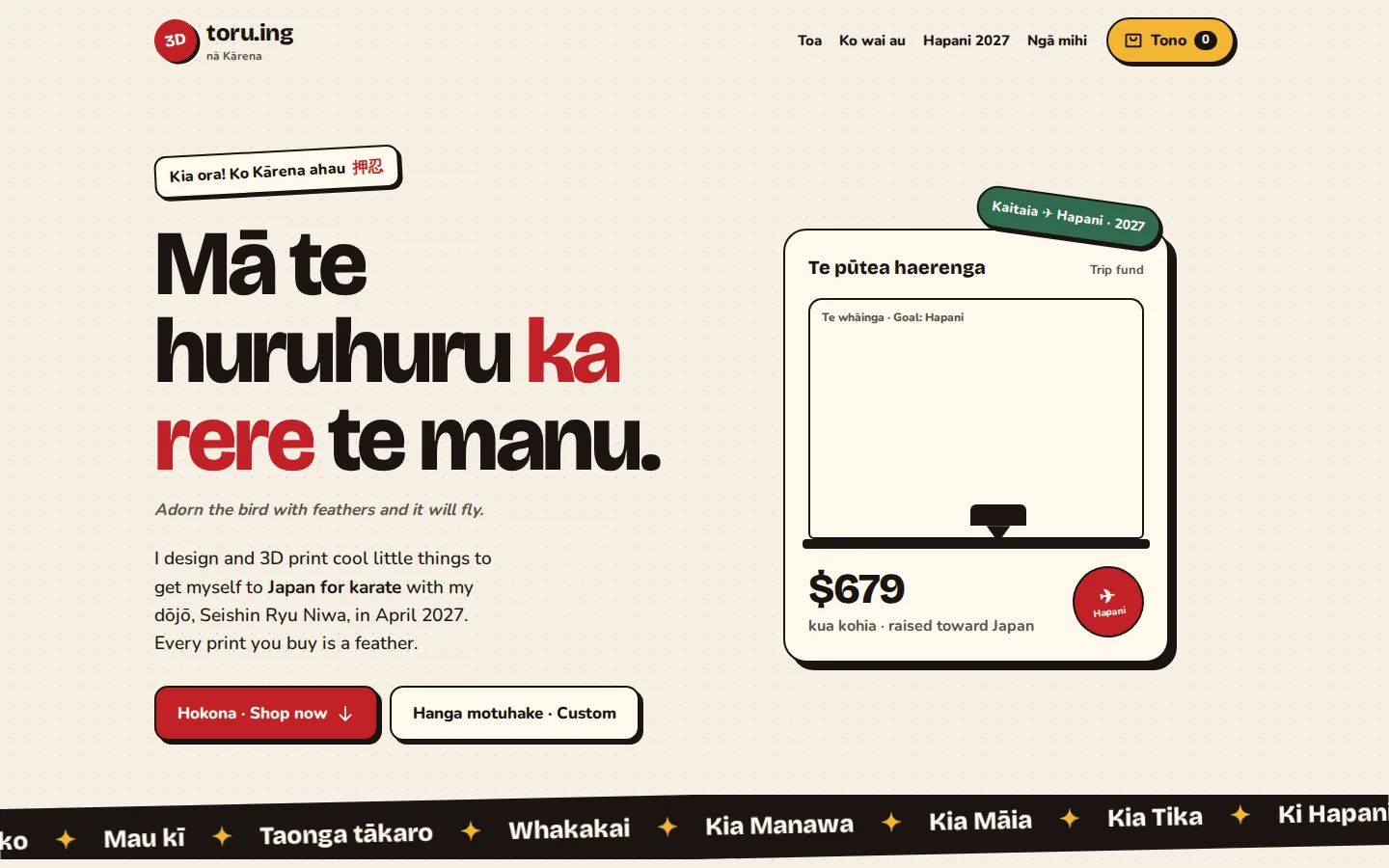
toru.ing is a rangatahi's 3D-print shop in Kaitaia, raising money for her dōjō's karate trip to Japan in April 2027. Buyers order and pay on the site, and every order, payment and print still to make comes together on one private board.
3D-print shop · Kaitaia, Far North · A whānau kaupapa
The problem
Made-to-order prints, and a lot to keep track of
Every print in the shop is made to order, at home in Kaitaia. That means every sale carries more than a price.
- Many prints need details only the buyer knows: a colour, the name on a name keychain, a kura logo.
- Some buyers want their order posted. Others pick it up in Kaitaia and would rather pay cash.
- Money only counts once it has been paid, so an order on its own cannot go on the fund total.
- The printer works one plate at a time, so it helps to know how many of each print are waiting.
What we put in place
One shop, one board, one print list
A one-page shop with te reo Māori first and English alongside it, and a private side for running it.
The shop.
Figurines, fidgets, keychains, earrings and desk pieces, sorted by type. Custom and bulk requests are welcome, such as a kura or club logo turned into keychains.
Pay when you order.
Buyers choose delivery or pick-up and pay by card through Stripe. Pick-up in Kaitaia can be paid in cash instead.
Questions without paying first.
A buyer can send a question about a custom piece without paying, and get a quote back.
Emails that look like the shop.
Every email to a buyer or to the shop uses the same look as the site, in te reo and English.
The owner board.
A private board, made for a phone, that shows each order from being priced to paid, made and handed over, refunds included.
The print list.
Paid orders grouped by print, with each buyer's notes, so a whole plate of the same print can be ticked off in one go.
The trip fund meter.
The meter on the home page counts money actually paid through the shop, not orders placed.
The thank-you wall.
Buyers who pay can choose to have their first name shown on the wall of supporters.
Found and shared.
Search engines can read the prints and their prices, and a link shared on Facebook shows a picture.
How it fits together
One record for every order.
An order is saved before anything else happens. The board, the print list, the fund meter and the thank-you wall all read from that one record.
Stripe confirms the money.
An order only counts as paid when Stripe says so, and a regular check catches a payment that Stripe took but the shop never heard about.
Made for a phone.
The shop, the board and the print list all work on a phone screen, so the shop can be run without sitting at a computer.
What changed
A new way of working
These are the practical changes now in place.
Paid at the time of ordering.
Card buyers pay as they order, instead of waiting for a pay link by email.
Cash where it makes sense.
Pick-up in Kaitaia can still be paid in cash.
One list of what to print.
Paid orders turn into a print list grouped by print.
A fund total that is real.
The meter moves when money is paid, not when an order is placed.
Supporters thanked, with their say-so.
Only buyers who opt in appear on the thank-you wall, and only by first name.
Still evolving
toru.ing keeps growing alongside the fundraiser, with new prints added as they are designed, all the way to the trip in April 2027.
Selling something you make to order?
If your orders, payments and what's left to make live in different places, let's kōrero about putting them in one.
Book a kōreroNo obligation.